Paper facts  

Metric paper sizes


ISO A Series


The most common system of sizing paper is the ISO standard “A” series developed in order to bring standardisation to paper sizes and is widely used in the world of printing. Most people are familiar with this system and a basic understanding is useful in order to reduce wastage and ultimately save costs. All “A” paper sizes are for the trimmed, finished product and are derived from the base unit A0 (841 x 1189mm), being one metre square.

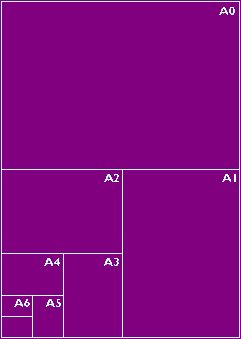
The general rule is each time you fold the piece of paper in half, along its longest side, the size increases by one, or put another way, a sheet of A4 folded in half will give you two sheets of “A5”. This is highlighted in the diagram below left, which illustrates the relationship between the different “A” sizes and shows they have the same proportions

Size

Millimetres

Inches

A0

841 x 1189

33.11 x 46.81

A1

594 x 841

23.39 x 33.11

A2

420 x 594

16.54 x 23.39

A3

297 x 420

11.69 x 16.54

A4

210 x 297

8.27 x 11.69

A5

148 x 210

5.83 x 8.27

A6

105 x 148

4.13 x 5.83


ISO “B” Series 

Providing intermediate sizes for the “A” series, but they are rarely used.

Size

Millimetres

Inches

B0

1000 x 1414

39.37 x 55.67

B1

707 x 1000

27.83 x 39.37

B2

500 x 707

19.68 x 27.83

B3

353 x 500

13.90 x 19.68

B4

250 x 353

9.84 x 13.90

B5

176 x 250

6.93 x 9.84

B6

125 x 176

4.92 x 6.93


ISO “C” Series

Envelopes have their own scale and need to be able to accommodate an “A” sized sheet. A C4 envelope will hold a flat sheet of A4 and DL will hold an A4 sheet folded into thirds.


Size

Millimetres

C0

917 x 1297

C1

648 x 917

C2

458 x 648

C3

324 x 458

C4

229 x 324

C5

162 x 229

C6

114 x 162

DL

110 x 220


ISO “RA” Series

As the “A” Series relates to the finished, trimmed sizes, an equivalent oversized sheet is needed from which to print and trim them out. RA and SRA allow for different amounts of trimming.


Size

Millimetres

Inches

RA0

860 x1220

33.86 x 48.03

RA1

610 x 860

25.02 x 33.86

RA2

430 x 610

16.93 x 24.02

SRA0

980 x 1280

38.58 x 50.39

SRA1

640 x 900

25.20 x 35.43

SRA2

450 x 640

17.72 x 25.20


(ISO paper sizes are normally measured in millimetres and rounded to the nearest one)

Paper types

Art paper

This term is used to describe the best quality of coated papers that have a coating of china clay or other mineral applied to each side of the sheet. They are then “calendered” by steel rollers to give an even, well-closed surface providing uniform ink absorption and a smooth highly polished gloss finish.

Bond

A grade of writing or printing paper where strength, durability and permanence are essential. Mainly used for letterheads, stationery and business forms. It has an uncoated finish and is available in a variety of colours.

Cast coated paper

This paper has a very high gloss finish achieved by using a special coating and the surface is then polished by stainless steel drying cylinders.

Coated paper

Paper that has received a coating providing an even surface.

Laid

Uncoated paper often used for business stationery which has a texture pattern of parallel lines similar in appearance to hand made paper.

Matt coated

This paper has calcium carbonate added during its production to give it a more satin effect. These papers tend to be more prone to marking when printed and generally need to be sealed.

Matt finish

Dull paper finish without gloss or lustre.

Newsprint

Mechanical pulp printing paper containing a small percentage of chemical wood pulp specifically manufactured in low grammage (45-50gsm) for the printing of newspapers.

Part mechanical

A paper containing up to 50% mechanical pulp with the remainder being chemical pulp.

Pulpboard

Matt uncoated boards in white or tinted ranging from 200micron thickness to 750micron.

Recycled

Paper made from all or in part from recycled pulp.

Uncoated

Paper that has not been coated in clay.

Woodfree

Paper free from mechanical wood pulp.